by Andrea Howe | Feb 29, 2016 | Monthly-ish tips
This post is part of our Weekly Tips series.
I was searching through unfinished blogs the other day and found one to share with you. It’s about how attempts to be helpful can backfire in a big way.
by Andrea Howe | Jul 20, 2015 | Monthly-ish tips
This post is part of our Weekly Tips series.
You know that trust doesn’t just happen. It gets created person-to-person, and usually through conversations. The trust creation process, which was first shared by my co-author Charlie Green in his book The Trusted Advisor, is a five-step model describing how it works: engage, listen, frame, envision, and commit (“ELFEC” for short).
by Andrea Howe | Apr 26, 2014
[four_col pos=”first”]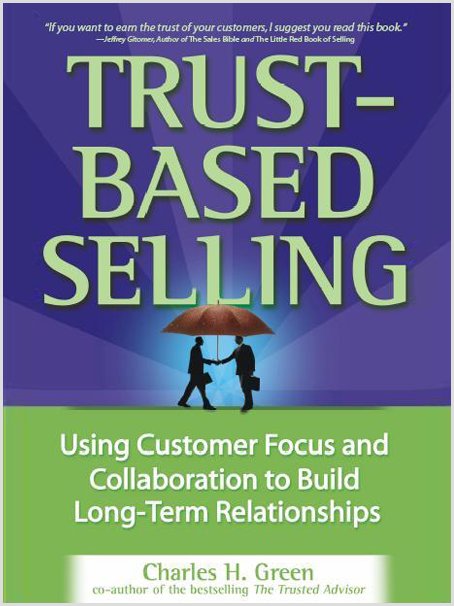 [/four_col][six_col pos=”last”]
When you were young and someone asked you what you wanted to be when you grew up, did you say “salesperson?”
Probably not. And yet now in your job you’re expected to develop new business, expand existing accounts, secure follow-on—whether your business card has “sales” or “business development” in the title or not.
The good news is that a whole new level of sales mastery is available to you.[/six_col]
Transform your results by transforming your relationship to selling
The Get Real Project’s partnership with Trusted Advisor Associates brings the philosophies and practices of Trust-Based Selling to life.
“The program opened up our minds about trust-based relationships. This is greatly beneficial to anyone in sales”–Participant, 2011
We approach sales programs on three dimensions:
- Focus on mindsets. We believe that how you think about selling is a key differentiator for anyone in a sales role—formally or otherwise. So we begin with a context that is other-focused and service-oriented.
- Start with being trustworthy. Trust-based selling pointedly is not about closing, being assertive, or attempting to meet a client’s every need. We teach you how to listen, understand wants and needs, and approach customers in an open, transparent way.
- Confront the discomfort with “selling.” A lot of people are afraid of selling—or at least uncomfortable with it—because it seems, well, smarmy. Our programs specifically address how to take the “sell” out of “selling.”
Our paradigms and approaches can be applied to any sales model or methodology.
WHO SHOULD PARTICIPATE
This program is ideally suited for:
- Salespeople and sales managers
- Business developers
- Account managers
- Client relationship managers
- Project managers and front-line consultants who are expected to help develop business
Involve your entire organization or strategically targeted groups.
Note: CPE credits are available for our Trust-Based Selling workshops.
HOW THE PROGRAM WORKS
We always tailor a program to match your real needs. Choose one of the following or combine several for maximum impact:
- Customized, stand-alone workshops (usually one to three days, staggered or sequential)
- Keynotes and mini-modules to add to off-sites, workshops, and other scheduled events
- The Trust Quotient diagnostic
- Your 30-day experiment
WHAT YOU’LL GET
Exact outcomes depend on the scale and duration of a program. Here’s a sample list of program objectives:
- Understand selling, trust-building, and the relationship between them
- Learn answers to the six toughest sales questions that will both set you apart and put you at ease
- Recognize the four essential elements of trust, and boost personal scores on each
- Apply specific techniques to avoid the trap of “premature solutions” and uncover true client wants and needs instead
- Discover ways to get your advice heard and acted on.
KEY TAKEAWAYS FROM PAST PARTICIPANTS
Here’s a sampling of what our clients have said they’ve learned:
Buying and Selling
- “People buy heavily through the non-rational parts of their mind”
- “Just because they said ‘tell us about yourselves’ doesn’t mean they want you to”
- “Price and features competition is just the absence of relationship”
- “Mention money earlier, not later”
- “Buyers buy the seller not the product”
|
Business Development
- “Selling by doing is more powerful than selling by telling”
- “Focus on this client’s issue, not the last one’s issue”
- “We almost never listen enough”
- “Be curious, be courageous, be yourself”
- “Put yourself in their shoes”
|
Client Relationships
- “Somebody must take the first risk: me”
- “It’s about the client, not me”
- “Client focus is personal, psychological, starts with me”
- “Intentions matter; clients can tell”
- “A lot of this is about personal courage”
- “Ask the tough questions, they pay off”
- “Listen, listen, listen”
|
Problem-Solving and Influence
- “Expertise is necessary, not sufficient”
- “Better to say you don’t know when you don’t”
- “Do not accelerate to the solution too soon”
- “Clarifying the problem is where value-add happens”
- “You have to earn the right to be right”
|
“I am pleased to report that the program was a phenomenal success with our Business Development team! There were rave reviews … and quite a few AHA moments from various people in the room”–Margaret Miceli, B2B Trust
WHAT ELSE TO EXPECT
There is no trust without risk, and there is no sales transformation without it, either. In our programs, we discuss thought-provoking concepts, teach tough lessons, and engage in candid conversations. We focus on helping you develop new mindsets as well as skill sets by using:
- Intellectually challenging models, paradoxes and stories
- Real client situations (yours)
- Customized caselets
- Role-playing
- Other experiential learning
Read a real client story. Find out more in our nine-point checklist for successful trustworthiness training. Or talk to us about bringing this program to you.
by Andrea Howe | Mar 21, 2014
Being masterful with business relationships takes something, both organizationally and personally. In fact, it takes a commitment to four things.
When you get real, you:
- Challenge the myths and misperceptions about relationship success. When you fundamentally change how you see relationship dynamics by getting smart about how relationships really work, then new and different choices become available. And when you act on those new and different choices—individually and collectively—things shift. Difficult clients start to listen more. People who were aloof begin to take interest. Results that were once incredibly hard to achieve come more naturally and easily. The key: re-learning what has always been taught about relationships; debunking the conventional wisdom that’s often just plain wrong. (For a new and different take on relationship wisdom, check out The Get Real Manifesto.)
- Know what makes you successful. There’s value to be gained from being crystal clear about your relationship strengths—as an individual and as an organization. It’s like knowing the details of a tried-and-true recipe: when something unexpected occurs, you’re more likely to create something exceptional because you know how to produce results reliably and consistently (even with a little dash of improv). And when you’re expected to teach someone else how to make the signature dish, you can. (For immediate feedback on your relationship strengths, try our Get Real Self-Assessment.)
- Get honest (and accurate) about your limitations. Having weaknesses (individual or organizational) doesn’t hurt your ability to improve your relationships (in fact, we implore you to be human in our Manifesto). The problem is being unaware of those weaknesses, or misjudging them. Discovering the truth (wc) is like taking off blinders that that have been blocking your peripheral vision—unbeknownst to you. When you see the opportunities you’ve been missing, you can seize them. When you know what there is to work on, you can acknowledge it and get to work. (For insight into your own opportunities for improvement, try our Get Real Self-Assessment.)
- Practice and persist. The Greek philosopher and scientist Aristotle once said, “We are what we repeatedly do. Excellence, then, is not an act but a habit.” Malcolm Gladwell brought this to our attention in modern times in his book Outliers: The Story of Success. A common theme throughout the book is the “10,000-Hour Rule,” based on a study by psychologist Anders Ericsson, suggesting mastery in anything requires a 10,000-hour investment.
It takes practice to become natural. We all need a certain amount of toughness, perseverance, and support to be masterful. Once you know your weak spots when it comes to developing prosperous and satisfying relationships, then the key is to find practices that are going to really help you—practices that are easy, and even enjoyable. (If you’d like, you can start now with a 30-day experiment.)
A note about the four keys to better results: none are rocket science.
On some level, they’re all ridiculously simple. They’re just not easy.
Fortunately, help is available.